Rome rarely explains itself directly. It prefers to leave clues.
Roman Symbols Explained: How Rome Speaks Beyond Words
Published on
Look closely at a fountain, a church façade, a manhole cover, or the base of an ancient monument, and you will begin to notice the same images appearing again and again: four mysterious letters, eagles with open wings, wolves, keys, laurel wreaths, family crests, and even Egyptian hieroglyphs.
These Roman symbols are part of the language of the city. Some date back more than two thousand years, others belong to popes and noble families, while many have changed meaning several times over the centuries.
Learning to recognize them adds another layer to exploring Rome. Suddenly, streets you thought you knew begin telling stories.
Why Symbols Matter so Much in Rome
For much of Rome's history, images communicated ideas faster than words. A symbol could identify political authority, celebrate military victory, honor a family, express religious devotion, or remind passersby who had paid for a building.
That makes the city feel almost like an enormous visual archive. Ancient Rome, medieval Christianity, Renaissance papal power and modern civic identity often occupy the very same streets.
Symbols are one of the easiest ways to see those periods overlapping.
A Roman eagle carved into ancient stone might speak of imperial authority. A coat of arms above a fountain can reveal the pope who commissioned it. Egyptian hieroglyphs beneath a Christian cross may tell a much more complicated story about how Rome repeatedly reused the past.
The key is knowing where to look.
SPQR: Four Letters that still Belong to Rome
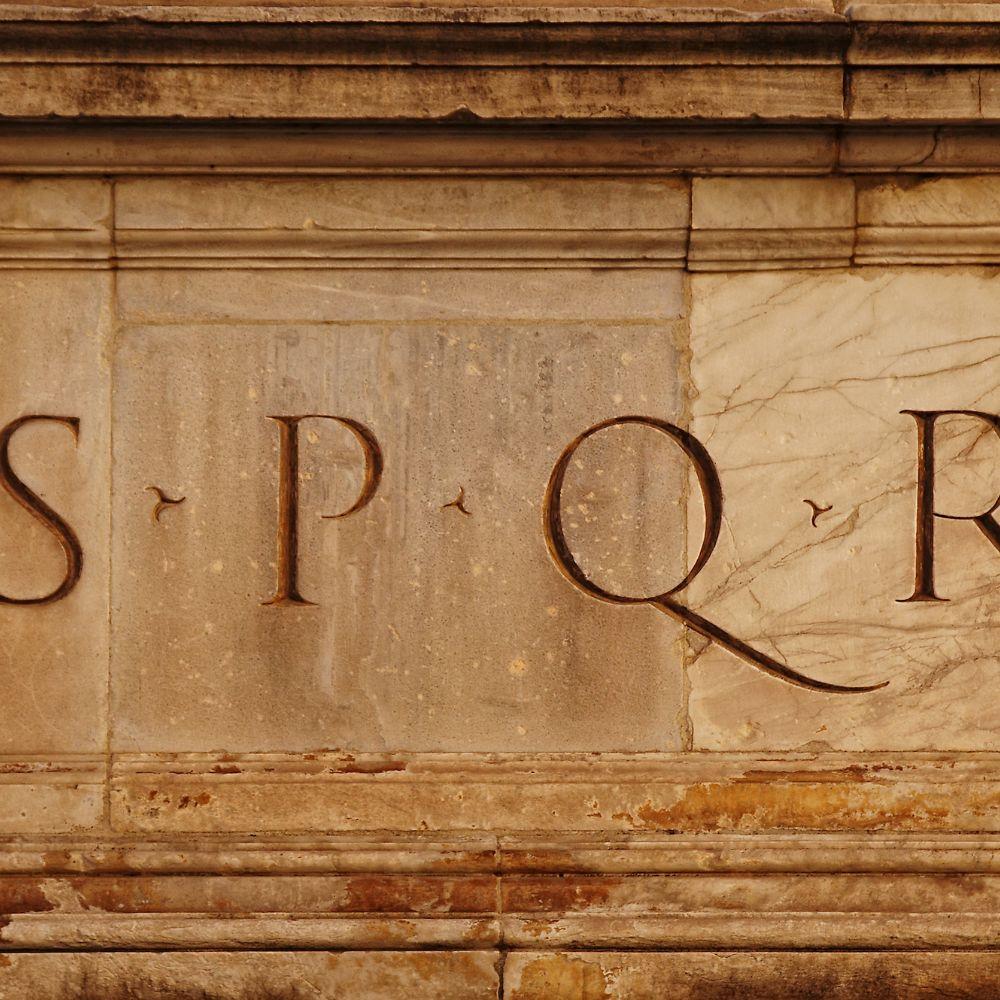
Few symbols of Rome are as easy to spot as SPQR. You will see the letters on monuments, fountains, municipal buildings and, perhaps most memorably, on the city's manhole covers.
SPQR stands for Senatus Populusque Romanus, usually translated as"The Senate and the Roman People". The formula was associated with the Roman state and appeared on inscriptions, public monuments, and other official contexts in antiquity. Remarkably, it remains part of the visual identity of Rome today.
That continuity is what makes the SPQR meaning particularly interesting for travelers.
You might spend the morning seeing the abbreviation connected to the political world of ancient Rome and encounter the same letters again that evening while walking through a modern neighborhood.
Rome has changed enormously. Its four famous letters have proved much harder to dislodge.
What does SPQR really tell us?
At first sight, SPQR looks like little more than an abbreviation. Historically, however, it represented an idea of public authority connected to both the Senate and the Roman people.
Its survival also reveals something very Roman: the city rarely abandons its past completely.
Instead, old symbols are absorbed into new versions of Rome. What once belonged to an ancient political system can later become part of a city's civic identity.
Once you know what SPQR means, you start seeing it everywhere.
The She Wolf: Rome Between History and Legend
Some Roman symbols lead us away from politics and into mythology.
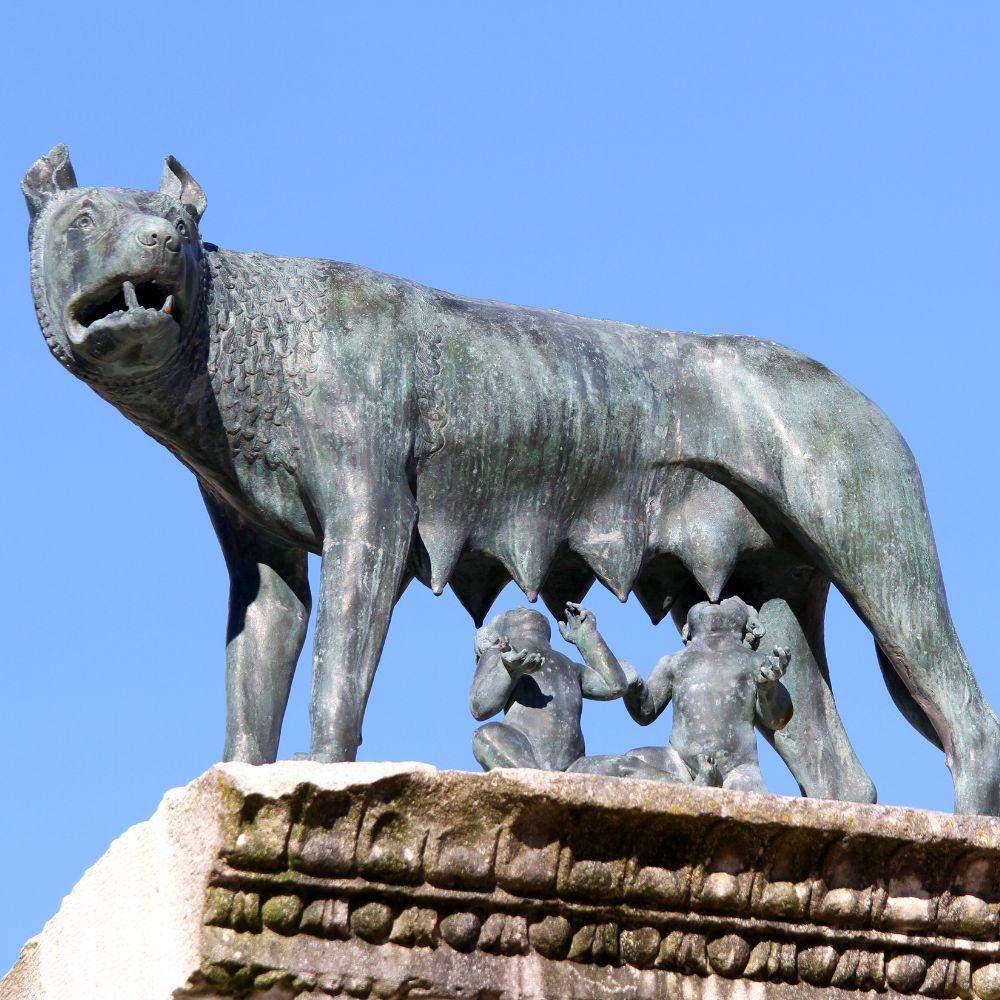
The she-wolf feeding the twins Romulus and Remus is perhaps the most recognizable example. According to Rome's traditional foundation story, the abandoned twins were rescued and nursed by a wolf before eventually becoming part of the myth surrounding the birth of the city,
For centuries, the image has represented Rome itself.
You may encounter the she-wolf of Rome on sculptures, souvenirs, civic imagery, and references to the city's ancient origins. It is one of those symbols where legend and identity have become almost impossible to separate.
For visitors, that is part of its charm.
Rome does not require every story to fit neatly into the category of historical fact. Myth has always been one of the ways the city explains who it believes itself to be.
Romulus, Remus and the idea of Rome
The story becomes more complicated after the famous image of the nursing wolf.
Romulus and Remus eventually come into conflict, and Romulus becomes the legendary founder and first king of Rome. The city's foundation myth therefore contains protection, ambition, rivalry and violence almost from its first chapter.
The she-wolf is consequently more than a picturesque image.
She points back to the moment when Roman history, legend and political identity begin to merge.
Eagles and laurel wreaths: the visual language of Roman power
Walk through archaeological sites in Rome and certain motifs begin to repeat themselves.
Among the most recognizable are the Eagle and the laurel wreath, two images strongly connected with authority, victory, and status in Roman world.
Understanding these ancient Roman symbols makes monuments easier to read because Roman decoration was rarely chosen simply to fill empty space.
The Roman eagle
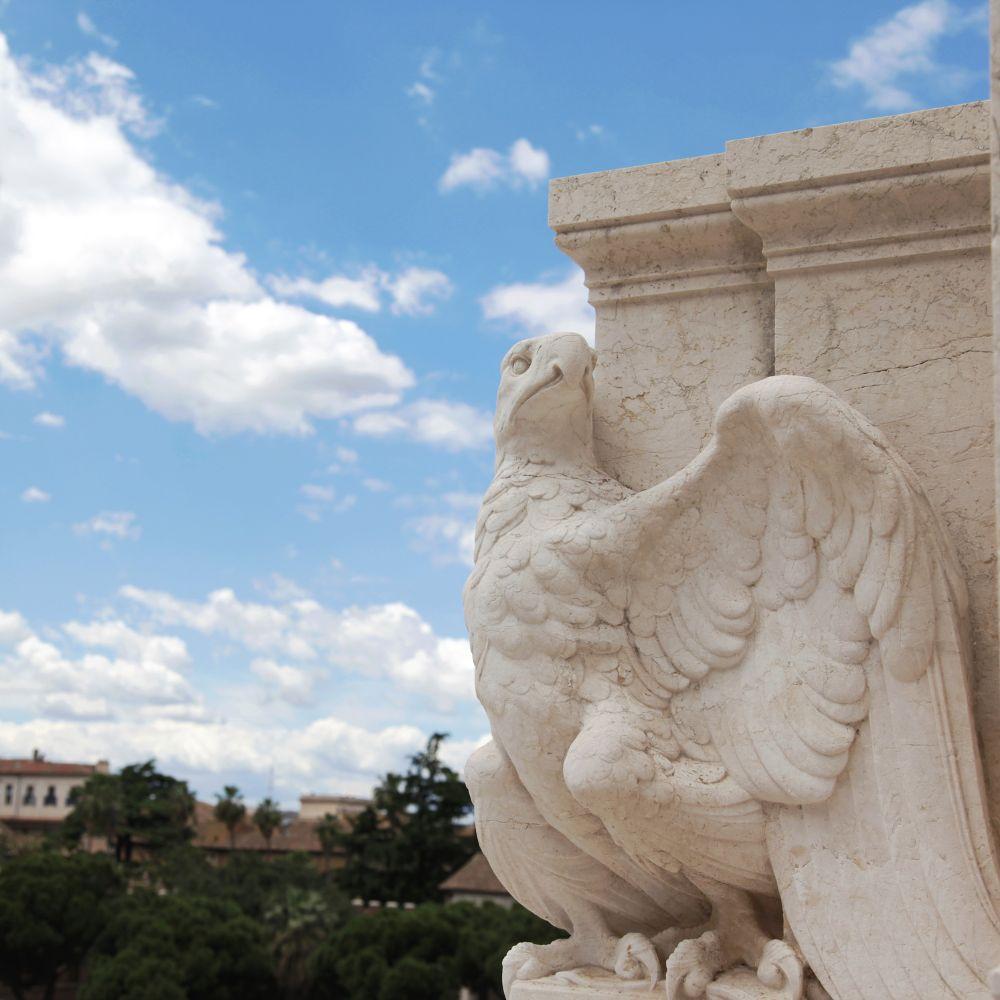
The eagle became one of the strongest images associated with Roman military and imperial power.
Roman legions used eagle standards, and the bird gradually became connected with victory, strength and Rome's expanding authority.
When an eagle appears on a monument, sculpture or in a military context, it is therefore worth asking what kind of power the image is trying to communicate.
In Rome, decoration often has an agenda.
Laurel wreaths and victory
The laurel wreath had deep associations with victory and honor.
Rome generals, emperors and public figures could be represented with laurel imagery, making it an immediate visual reference to achievement and prestige.
Today, the shape may seem familiar enough to overlook. But on an ancient relief or monument, even a small wreath can help explain how the subject wished to be seen.
This is one of the pleasures of understanding Roman symbols and meanings: details that once seemed ornamental begin to carry information.
Coats of arms: finding the people behind Rome's monuments
Not every important Roman symbol comes from antiquity.
Look above fountains, palace entrances and church façades, and you will often find elaborate coats of arms. These can identify the pope, cardinal, or noble family responsible for commissioning, restoring, or transforming a building.
Rome's famous families understood architecture as a form of visibility.
Their symbols appeared across the city, allowing residents to recognize immediately who was behind a particular project.
Once you learn a few of these emblems, Rome starts to become surprisingly personal.
Bees, dragons and family symbols
Some papal families used memorable visual motifs that are still easy to recognize today.
The Barberini family, for example, is famously associated with bees. Spend enough time around Baroque Rome, and you will begin noticing them on fountains, buildings, and decorative details.
Other families used animals, plants, stars and geometric forms.
You do not need to memorize every Roman coat of arms before your trip. The fun is realizing that these images are effectively signatures.
When you see the same symbol appearing across several monuments, there is usually a reason.
The keys of Saint Peter: recognizing papal Rome
Rome developed another powerful symbolic vocabulary as the center of the Catholic Church.
One of its most familiar images is the pair of crossed keys associated with Saint Peter. The symbol refers to the biblical idea of the keys to the Kingdom of Heaven and became closely linked to papal authority.
Around Vatican City and churches connected with the papacy, the image appears frequently.
This gives travelers an important clue when reading Rome: the same city that preserves imperial eagles and pagan monuments also communicates through an entirely different Christian system of symbols.
And sometimes those symbolic worlds are physically placed on top of one another.
Few monuments demonstrate this more clearly than Rome's obelisks.
Egyptian obelisks in Rome: when one monument carries several meanings
The obelisks in Rome are among the most dramatic examples of how monuments can acquire completely new identities.
They look perfectly at home in Roman piazzas today, yet many originated thousands of miles away and centuries before Rome became an empire.
Their story passes through ancient Egypt, Roman imperial politics, Renaissance urban planning, and Christian symbolism.
What did obelisks mean in ancient Egypt?
In their original Egyptian setting, obelisks were religious monuments closely connected with solar symbolism, temples, and royal authority.
Their tall, tapering form directed the eye upward and associated the ruler with divine power and the sun.
Their hieroglyphic inscriptions could record the names and achievements of pharaohs, placing political and sacred meaning on the same surface.
For Roman emperors, monuments like these possessed enormous prestige.
And Rome did something it has continued doing throughout its history: it took an existing symbol and gave it another context.
How Egyptian obelisks reached Rome
Following Roman control of Egypt, emperors transported several ancient obelisks to Rome.
Moving enormous single blocks of stone across the Mediterranean required extraordinary engineering and resources. Special ships carried them from Egypt before Roman machinery was used to raise them again in the capital.
Augustus was among the rulers who brought Egyptian obelisks to Rome, while later emperors continued the practice. Rome today contains thirteen ancient obelisks, including ancient Egyptian examples and obelisks created in the Roman period.
Their presence communicated more than admiration for Egyptian art.
Placing an Egyptian monument in Rome also demonstrated imperial reach. An object once associated with a pharaoh could now stand at the center of Roman public life.
From Egyptian monument to Roman landmark
Obelisks appeared in important Roman spaces, including circuses and the Campus Martius.
The obelisk now standing in Piazza del Popolo, for example, was brought to Rome during the reign of Augustus and originally stood in the Circus Maximus. Centuries later, Pope Sixtus V had it moved to Piazza del Popolo.
Another Egyptian obelisk, now in Piazza Montecitorio, was incorporated into August's monumental project in the Campus Martius and used in connection with a vast solar installation.
The monument remained ancient Egyptian stone, but its surroundings had changed.
And so had its message.
How the obelisks survived
Many ancient monuments disappeared because their stone and marble were reused in later buildings.
Rome's obelisks followed a different path.
Some fell, broke, or remained buried for centuries before being rediscovered. During the Renaissance, popes began recovering and repositioning them in prominent locations.
Under Pope Sixtus V in particular, several obelisks were incorporated into a new vision of Rome.
They became visual markers within the city, helping organize important sites into a new vision of Rome.
The ancient monument was no longer simply being preserved. It was being given another job.
When Egyptian symbols became Christian
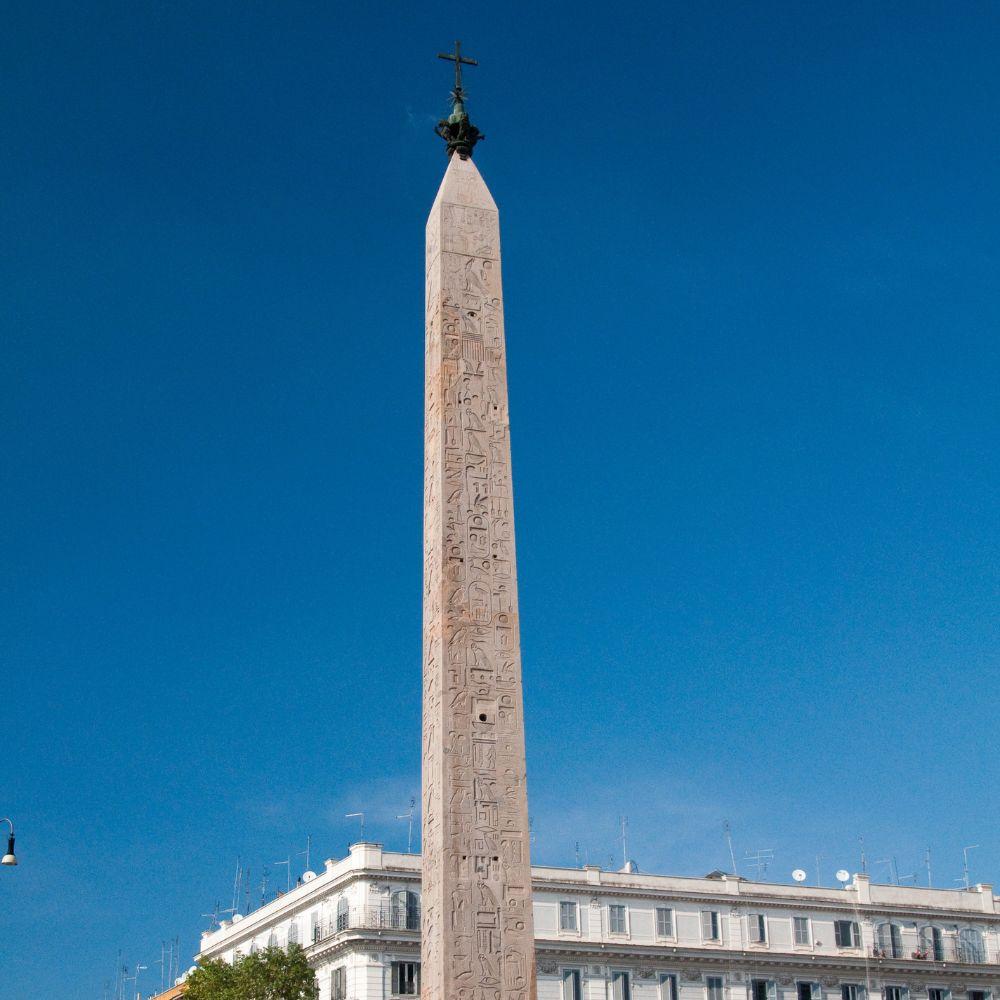
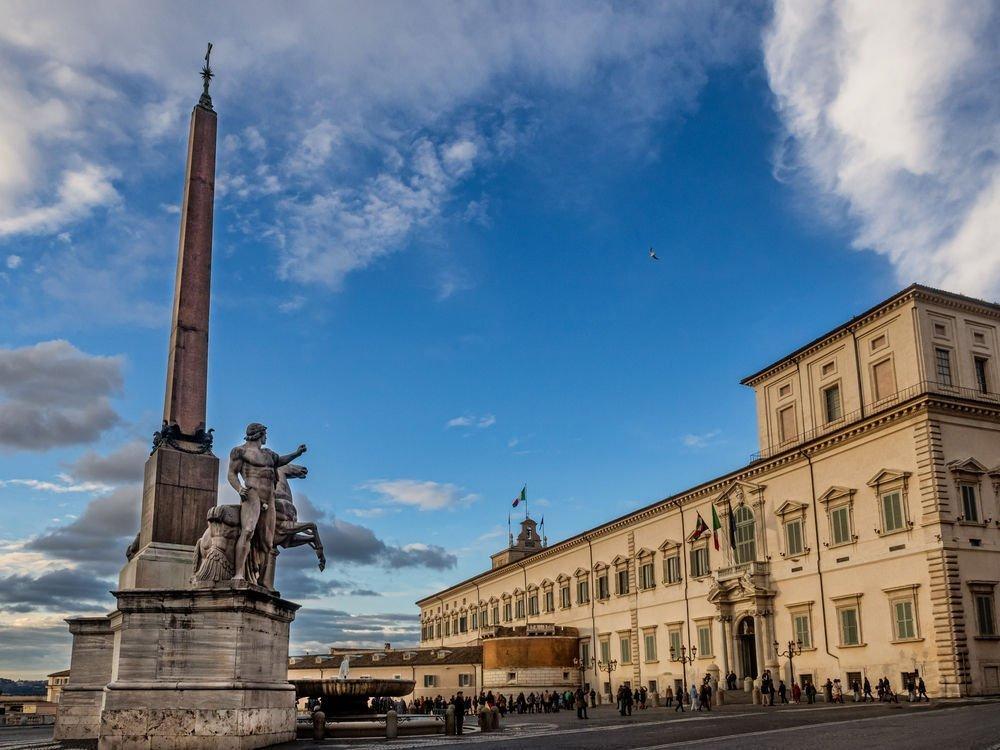
Look at many Roman obelisks today, and you will notice something striking at the very top: a Christian cross.
That detail perfectly summarizes Rome's ability to reinterpret its past.
An object created within an ancient Egyptian religious system could be transported by Roman emperors, rediscovered centuries later, and then crowned with one of Christianity's most recognizable symbols.
When Sixtus V repositioned ancient obelisks, crosses were added as part of their Christian reinterpretation. At St. Peter's Square, for example, the Vatican obelisk was moved to its present location in 1586, and its earlier bronze sphere was replaced by a cross.
The Flaminian Obelisk in Piazza del Popolo was similarly given a Christian cross when it was reinstalled under Sixtus V.
The hieroglyphs were not erased.
That is what makes the result so fascinating.
Egyptian inscriptions, Roman imperial history, and Christian imagery can all exist on the same monument.
Obelisk and the shape of modern Rome
The repositioning of obelisks also influenced the way visitors experience Rome physically.
They were placed in important squares and near major churches, becoming vertical reference points within the urban landscape.
The Flaminian Obelisk helps define Piazza del Popolo and the beginning of Rome's famous Trident, the three roads extending into the historic center. The Lateran Obelisk dominates the space beside San Giovanni in Laterano, while the Vatican Obelisk forms the central axis of St. Peter's Square.
Today they help us navigate Rome.
But if you know their history, they also help us navigate time.
How to read Rome's symbols
You do not need to be an archaeologist or art historian to begin interpreting the symbols around you.
A few simple questions can turn an ordinary walk into a surprisingly rewarding exercise in observation.
- What am i looking at? Is it an animal, inscription, religious image, family crest, or decorative motif?
- Where does the symbol come from? Does it belong to ancient Rome, Christianity, a noble family or another culture entirely?
- What did it originally mean? Symbols change, so their first meaning may be very different from the way they were later used.
- Why is it being used here? Its position can be just as important as the symbol itself
Look at inscriptions, coats of arms and details above eye level. Notice motifs that appear repeatedly on the same building or across several monuments.
Most importantly, consider when the monument was built or altered.
A symbol carved on an ancient triumphal monument cannot automatically be interpreted in the same way as a similar image added to a seventeenth-century church façade.
Recognizing the symbol is only the beginning.
Understanding who commissioned it, why it appears in that particular place, and how its meaning changed over time is what turns observation into a story.
Discover the stories behind Rome's symbols
Rome becomes much easier to read once you start noticing its visual clues. But many of the most interesting connections are difficult to discover from a guidebook alone.
A knowledgeable guide can explain why an emblem appears on one fountain but not another, connect a coat of arms with the family that reshaped an entire neighborhood, or show how an ancient object was reused hundreds of years after it was created.
For travelers who enjoy asking questions and following these details, Walks Inside Rome's private and small group experiences offer a more interactive way to explore the city and place what you are seeing within its historical and artistic context.
Because in Rome, the smallest symbol can sometimes lead to the biggest story.

Written by
Salvatore Barberi
Salvatore Barberi is the Co-Founder of Walks Inside Rome & Italy, and a travel industry professional with more than 25 years of experience creating memorable journeys throughout Italy. His expertise spans private tours, tailor-made travel, cultural experiences, and Italian food and lifestyle. Over the years, he has developed a deep understanding of what makes a journey through Italy truly meaningful, combining local knowledge, attention to detail, and a strong focus on authentic experiences.
Back to top


